The 1-3-5 Rule: A Simple Framework for Daily Prioritisation
The 1-3-5 rule is one of the most practical tools for planning a realistic, focused workday. Here is what it is, why it works, and how to use it.
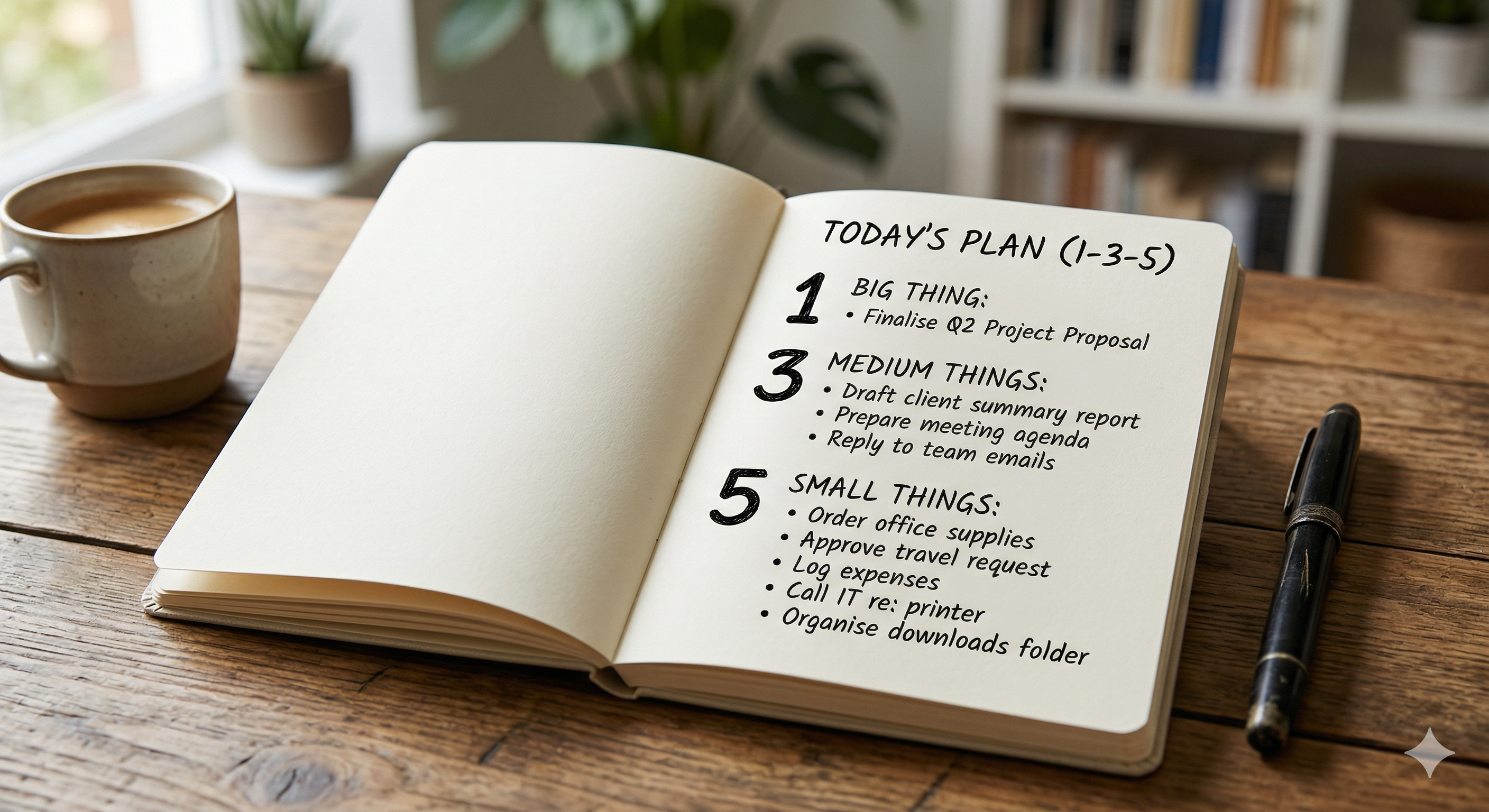
Most approaches to daily planning fail for one reason: they do not account for the limited capacity of a single human workday.
You start with good intentions and a long list. By the afternoon, you have handled whatever was loudest, put out a few fires, answered a lot of emails, and the important thing you intended to focus on has not been touched.
The 1-3-5 rule is a simple structure that prevents this.
What the 1-3-5 Rule Is
The rule is this: each day, you plan to accomplish:
- 1 big thing - one substantial, meaningful task
- 3 medium things - three moderately important tasks
- 5 small things - five minor tasks or quick items
Nine items total. That is your day.
The rule was popularised by Alex Cavoulacos of The Muse, though the underlying logic has been rediscovered independently by many productivity thinkers. It works because it builds a realistic constraint into the planning process from the start.
Why Nine Items, and Why in That Proportion?
The distribution reflects how time and cognitive energy actually work.
A “big thing” is a task that requires substantial focus and will likely take 1-3 hours or more. You can realistically accomplish one of these in a day, maybe two on an unusually productive day. Attempting three or four big tasks in a single day is a plan for failure.
“Medium things” are meaningful but more bounded: a focused meeting, an important email that requires thought, a piece of analysis, a phone call that needs preparation. You can usually handle three of these without them crowding out the big work.
“Small things” are the operational texture of the day: quick replies, brief admin tasks, simple approvals, short errands. Five is about the right number before these start consuming more time than they are worth.
Together, nine items is ambitious but achievable. It is enough to feel like a productive day without being a list that mocks you by the end of it.
The Most Important Part: Deciding What the Big Thing Is
The 1-3-5 rule is only as useful as the thought you put into choosing your one big thing.
The big thing should not be the most urgent item. It should be the most important one, the task that will have the greatest impact on your work, your goals, or the people depending on you. Urgency and importance are different axes, and most people default to urgency because it demands attention. Important things rarely shout.
Ask yourself: if I could only accomplish one thing today, what would make this day genuinely worth its cost in time and energy? That is your big thing.
Schedule it first, ideally in your best hours. Everything else works around it.
Applying the Rule in Practice
The night before is the best time to plan. Your subconscious will work on the problems overnight, and you will start the day with intention rather than scrambling to figure out what to do first.
- Review what is left from today and what is coming up tomorrow.
- Identify your one big thing.
- Choose three medium items that genuinely need to happen.
- Note five small tasks you can batch together.
- Write them down somewhere visible.
When things come up during the day, and they will, you have two choices. If the incoming request is more important than something on your list, swap it in and push something else to tomorrow. If it is not more important, either defer it or add it to tomorrow’s plan.
The list is not rigid. It is a plan. Plans get adjusted. The value is in having made the plan at all.
What to Do When You Cannot Identify a Big Thing
Some days feel genuinely full of medium and small things, with no obvious single priority rising above the rest. This is a signal worth paying attention to.
If you regularly struggle to identify a big thing, one of a few things may be happening. You may be caught in purely reactive work, responding to others’ priorities rather than your own. You may have lost sight of longer-term goals. Or the important work might be present but uncomfortable, making it easier to fill the day with smaller tasks that feel more manageable.
On days like this, the most valuable big thing might be the thing you have been avoiding the longest.
Adapting the Rule
The 1-3-5 framework is a template, not a law.
Some people prefer 1-3-3 for particularly demanding types of work. Others adjust the categories to reflect their specific context. If your work is genuinely dominated by small, fast tasks, the ratio might shift.
The core principle is what matters: impose a deliberate constraint on how much you plan to accomplish, force yourself to decide what the most important thing is, and protect space for it. Everything else is adaptation.
A Note on What Does Not Fit
The 1-3-5 rule requires you to accept that not everything on your list will happen today. This is not a failure of the system. It is the system working correctly.
The items that do not make the cut go back on your master list for future days. The act of leaving things off today’s plan is an act of prioritisation, which is the point. A day with nine focused items completed is more productive than a day with thirty items started and none finished.